Jev AI and a general-purpose large language model can both interpret text, but they are designed to return different kinds of answers. A conventional LLM generates a sequence of tokens. Jev is presented by TypeSafe AI as a model that returns predefined, typed decisions and probability information. That distinction affects what each model is useful for, how an application integrates it, and what “reliable” should mean.
The short version: Jev may be worth testing for a narrow decision step; an LLM remains the more natural fit when the output itself must be flexible language. Many workflows can use both.
How the output contract differs
With an LLM, a prompt can request JSON or a fixed set of labels. The application still needs to validate the response, handle malformed or missing fields, and decide what to do when the model refuses or responds in an unexpected way. Structured-output features can reduce those risks, but the application still owns validation and error handling.
TypeSafe describes Jev’s outputs as typed values whose shape is defined before inference. Its public materials describe questions that resolve to yes/no probabilities, one of several choices, or a score. This removes some text-parsing concerns by design. It does not remove the need to test whether the chosen value is right.
Comparison at a glance
| Question | General-purpose LLM | Jev AI, as described by TypeSafe |
|---|---|---|
| Primary output | Generated text, which can include structured formats | Predefined typed decisions and probability information |
| Best-shaped task | Drafting, explanation, dialogue, synthesis, and code generation | Constrained classification, choice, yes/no assessment, and scoring |
| Integration concern | Validate and safely consume generated content | Define the allowed decision schema and validate decision quality |
| Typical fallback | Retry, constrain the prompt, or use a parser and review | Escalate low-confidence, unsupported, or out-of-scope inputs |
This comparison is about task shape, not a universal benchmark. Specific LLMs can produce constrained outputs, and different models can vary substantially in cost, speed, and quality. Compare on the same examples before deciding.
When to use Jev AI
Consider Jev when the output is naturally a choice from a known set, a score on a defined scale, or a yes/no estimate. A customer-support system might need to decide which queue receives a message. A search pipeline might score candidate documents for relevance. A risk workflow might flag a case for review. These are candidate experiments, not a claim that Jev already beats established classifiers or rankers on each task.
Before using Jev, confirm the task is supported by the current API, define a representative evaluation set, and document the consequences of false positives and false negatives. A probability should be treated as a model signal that must be calibrated and evaluated for the specific task, not an automatic permission to take action.
When an LLM is the better fit
Use a language model when the application needs prose: a response to a customer, a summary, a plan, a code change, or an explanation for a human. Even when a task includes a decision, the surrounding workflow may need both a fixed answer and language. For example, the system can classify a ticket, then ask an LLM to draft a reply after a person or policy engine approves the route.
Do not make Jev generate an explanation if it is not designed for free-form language. Instead, let the application map an approved decision to a template, or pass the decision to a separate language model with the source context and guardrails.
A practical hybrid design
- Use deterministic rules for decisions that are already explicit in the data.
- Use Jev or a baseline classifier for the constrained judgment that remains.
- Apply thresholds and business rules in application code, not in an unchecked model response.
- Use an LLM only where generated language adds value, such as drafting a human-readable explanation.
- Record the model version, input, decision, confidence, downstream action, and later correction.
What others are saying about Jev AI
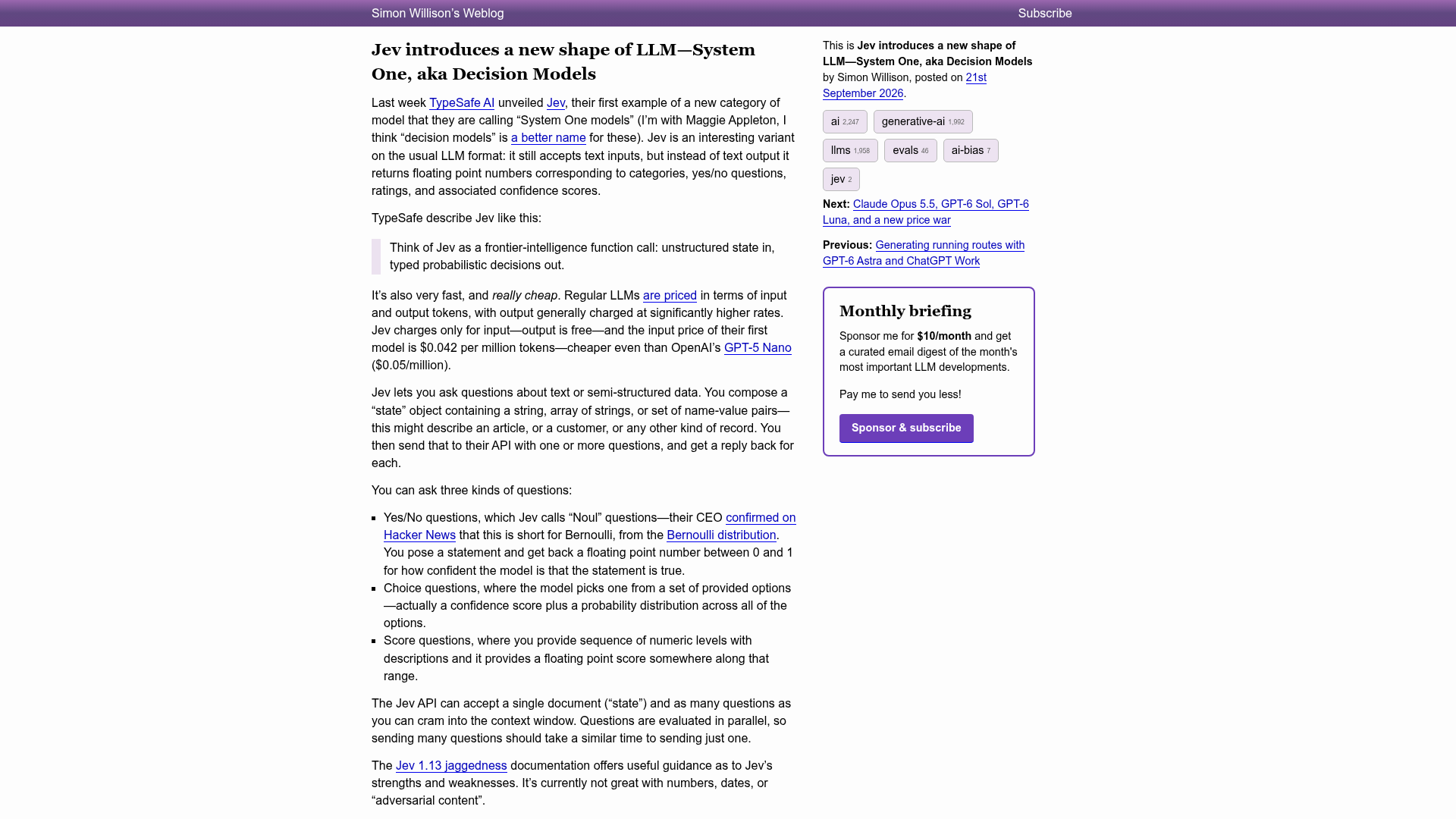
In his review of Jev, Simon Willison treats “decision model” as a useful framing and points to classification and reranking as plausible applications. He also highlights the black-box trade-off and limitations documented by TypeSafe. That is a more measured interpretation than saying Jev simply “replaces LLMs.”
KDnuggets’ analysis of the launch similarly separates potentially useful engineering from claims of an entirely new kind of AI. Its caution is relevant to comparisons: the public announcement alone does not establish a universal performance advantage across tasks.
Choose by task, not by label
Compare models with one representative workflow, a fixed evaluation set, and a clear baseline. Score correctness separately from output validity, latency, cost, review effort, and downstream impact. Jev is most compelling when its constrained answer matches the application’s need. An LLM is most compelling when the application needs flexible language. The right answer may be a pipeline that uses both.
Frequently asked questions about Jev AI vs. LLMs
Can Jev AI replace ChatGPT or Claude?
Not for all tasks. Jev is positioned for structured decisions, while general-purpose LLMs are designed to generate flexible language. Jev may complement an LLM within a larger workflow.
Can an LLM return structured JSON too?
Yes. Many LLM APIs support constrained or structured outputs. The comparison is not “structured output versus no structure”; it is about model design, output contract, performance on the task, and the validation the application needs.
Is Jev AI more accurate than an LLM?
There is no universal answer. Accuracy depends on the task, data, model version, evaluation method, and baseline. Test both on the same held-out examples.
Sources and further reading
- TypeSafe AI’s Jev announcement
- Jev developer documentation
- Simon Willison on Jev as a decision model
- KDnuggets’ independent Jev analysis
Start with the job the software must complete
The phrase “Jev versus LLMs” can make the choice sound like a contest between two brands. A better starting point is the job at the boundary of your application. Is the system expected to produce a paragraph, or is it expected to select a route? Does a person need to read an explanation, or does a queue, search index, or policy engine need one bounded value? Those questions are more useful than asking which model is generally smarter.
An LLM is naturally comfortable when the answer is language. It can summarize a case, transform tone, extract a draft, explain a decision, or continue a conversation. Jev is presented by TypeSafe AI as a decision-oriented component: the application describes a question and an allowed result, then receives a constrained decision with probability information. The TypeSafe announcement is the authoritative source for that positioning; the official documentation should take precedence for the current product contract.
This difference is not merely cosmetic. A language model can be asked to produce a label, but the prompt is only one part of the contract. The caller still has to validate the label, handle an unexpected answer, decide whether an explanation is trustworthy, and protect downstream actions. A decision-focused interface can make the desired boundary more explicit. It does not make the judgment automatically correct, and it does not remove the need for application controls.
Separate the decision from the explanation
Many products accidentally ask one model call to do two different jobs: decide what should happen and explain that decision to a customer. Those jobs have different acceptance criteria. A route such as technical_support can be checked against a label. A customer-facing explanation must be accurate, relevant, polite, and grounded in information the customer is allowed to see.
A safer design treats them as separate artifacts. First, a constrained model or established classifier proposes the decision. Next, deterministic policy checks whether that decision is permitted in the current state. Only then does a language model draft a message, if prose is genuinely needed. The draft can be templated from the approved value, reviewed by a person, or generated with the original evidence attached. This separation prevents a fluent explanation from becoming accidental evidence that the underlying classification was right.
The reverse pattern can also be useful. An LLM may summarize a long conversation into a compact, reviewable state, while a decision component evaluates that state against a finite question. In that arrangement, the summary is an input transformation that needs its own tests; it should not silently change the label definition. Keep the source record available for audit and give reviewers a way to inspect the evidence behind a recommendation.
Choose a boundary that a reviewer can understand
A good decision boundary is small enough that two people can describe it the same way. “Should this customer receive a good experience?” is too broad. “Does this message contain a request to cancel an existing subscription?” is narrower, but it still needs definitions for indirect requests, quotations, sarcasm, and messages that contain several intents. The choice between Jev and an LLM cannot rescue an ambiguous task.
Write the label contract
For every possible value, write a short definition, positive examples, counterexamples, and a review rule. State what information was available at decision time. If a record can contain multiple valid categories, decide whether the output is single-label, multi-label, or a prioritized route. If none of the options is safe, include an abstention path in the workflow even if the model interface itself only returns the original choices.
Define the unit of judgment
LLM prompts often grow until they contain an entire customer history. A decision component should receive only the state needed for the question. Define whether one decision applies to a message, an account, a document, a search result, or a group of records. Mixing units can make evaluation look better than deployment: a model may appear accurate when repeated messages from the same case are split across test sets, then fail when it sees a genuinely new case.
Assign a human owner
Someone should own the label policy and the escalation path. A model comparison is incomplete if nobody owns corrections after launch. A support lead may own queue definitions; a search team may own relevance judgments; a compliance team may own the policy for review. The model is a component in that process, not the person accountable for the outcome.
Compare the whole pipeline, not an isolated response
Jev and an LLM can appear very different when compared as raw API responses, yet deliver similar work after validation, retries, parsing, review, and action. Measure the complete path from input availability to a trusted result. Include preprocessing, request queuing, model time, validation, fallback behavior, and the time a human spends resolving uncertain cases.
| Dimension | Questions to ask | Evidence to collect |
|---|---|---|
| Task fit | Is the required result prose or a bounded value? | Label definitions and representative examples |
| Contract effort | How much caller logic is needed to accept a result? | Validation failures, retries, and rejected outputs |
| Quality | Does the result match the agreed ground truth? | Confusion matrix, error review, and disagreement reasons |
| Uncertainty | Can the system defer cases it does not understand? | Coverage, abstention rate, and accepted-case error |
| Operations | Can the team observe and reverse behavior? | Logs, version identifiers, rollback tests, and alerts |
Run the same inputs through each candidate, but avoid treating a single aggregate accuracy number as the verdict. A model that is slightly less accurate overall may be preferable if it catches the costly class, has a useful abstention option, or requires less reviewer effort. Conversely, fewer parsing errors are not a reason to accept more semantic mistakes. Keep contract validity, correctness, calibration, latency, and operational cost as separate columns in the evaluation.
Use an evaluation set that exposes the trade-off
A random sample is a useful beginning, not a complete test. Build slices that represent normal traffic, borderline examples, missing fields, unusually long inputs, multiple intents, new terminology, and records outside the supported scope. Include adversarial cases only in a controlled and documented way; the goal is to understand behavior, not to manufacture a dramatic score.
For an LLM, record whether the answer followed the requested format as well as whether its content was right. For Jev, record whether the selected value was valid as well as whether it matched the label. Review the disagreement set manually. The most informative question is often not “which model won?” but “what kind of case causes each model to fail, and what would the workflow do next?”
Use a time-based or group-based holdout when the data has temporal or relational structure. A future month can reveal terminology drift. A holdout by customer, conversation, document, or account can reveal memorization and duplication. Freeze the label guide and evaluation protocol before selecting the winner. If the team keeps changing the question after seeing results, it is measuring an evolving task rather than comparing models.
Independent commentary is useful for identifying questions that a launch page may not answer. Simon Willison’s discussion of Jev as a decision model points toward classification and reranking while drawing attention to limitations involving numbers, dates, and adversarial inputs. Those observations are prompts for local tests, not universal failure rates. Similarly, the KDnuggets analysis urges caution about broad novelty claims when public technical details are limited.
Design fallbacks before you select a model
A fallback is not simply “try another model.” It is the behavior the business can tolerate when the first answer is unavailable, invalid, uncertain, or out of scope. For a routing task, that may be a general queue. For search, it may be the existing ranker. For customer communication, it may be a draft held for approval. For a safety-sensitive action, it may be no automatic action at all.
Keep the fallback decision in trusted application code. The model should not decide its own permission to change an account, issue a refund, or disclose private information. Validate that the returned value belongs to the requested task and allowed set. Apply authorization, rate limits, idempotency, and business rules after the model response and before the mutation.
Test failures deliberately: timeout, partial response, incompatible version, empty input, duplicate request, malformed data, and a confidence value that does not meet policy. Record which fallback was used. A system that quietly retries forever can be more expensive and less reliable than one that makes uncertainty visible to a reviewer.
Where an LLM remains the better interface
Some tasks should remain language-first even when they contain a hidden decision. If the deliverable is a nuanced explanation, a multi-turn interview, a draft contract, a code change, or a summary for a person, an LLM provides the more natural interface. A finite label can be added as metadata, but it should not replace the prose that users need.
LLMs are also useful when the taxonomy is still being discovered. Early research may require clustering themes, proposing candidate labels, and showing examples that help a team refine its categories. Once the taxonomy stabilizes, a constrained decision component or conventional classifier may be easier to test. Do not force an immature policy into a rigid schema merely because structured output looks tidy.
There are also cases where a language model’s ability to ask for clarification is part of the product. A support assistant can ask a customer which account they mean; a fixed decision call may only be able to mark the case ambiguous. The application should choose the interaction style deliberately rather than treating ambiguity as a failure to be hidden.
Where a decision component may simplify the system
Jev is worth investigating when the surrounding software already knows what values it can accept and the main challenge is interpreting messy input into one of them. A bounded route can make downstream code simpler, make review queues measurable, and prevent a paragraph from being mistaken for a command. The advantage, if it appears in testing, is an interface fit rather than a universal claim about intelligence.
Start with a reversible path. Run the candidate in shadow mode beside the existing process, compare outputs, and sample disagreements. If the new path performs acceptably, automate only one low-risk action at first. Define a rollback condition before launch: for example, a rise in correction rate, an unexplained shift in class mix, or a failure in a material subgroup. Revisit the decision definition when the business changes; a stable model cannot compensate for an obsolete label contract.
A practical selection playbook
- Describe the output: write whether the deliverable is language, a finite choice, a score, or a combination.
- Define success: document the ground truth, error costs, acceptable coverage, and required review path.
- Build the baseline: include deterministic rules, the current system, or a simple classifier where appropriate.
- Prepare slices: reserve ordinary, ambiguous, out-of-scope, recent, and materially different examples.
- Measure the pipeline: include validation, retries, latency, reviewer effort, and downstream corrections.
- Inspect failures: classify errors by missing context, unclear labels, unsupported input, wrong reasoning, or policy issue.
- Choose the smallest authority: let the model recommend before allowing it to trigger a reversible action.
- Document ownership: name the person responsible for label changes, monitoring, appeals, and rollback.
This process can produce any of three conclusions: use Jev for the bounded step, use an LLM for the language step, or use neither because a rule or human process is better. A fair comparison allows all three outcomes. The strongest architecture is often a division of labor: deterministic code owns authority, a decision model handles a constrained interpretation, and an LLM communicates the approved result when people need language.
Keep the comparison honest as products change
Early-access products and model APIs can change their output semantics, limits, and behavior. Preserve the model identifier, decision definition, prompt or question text, evaluation data version, threshold, and policy version with every experiment. Re-run a small regression set after an update and repeat the full evaluation when the task or traffic changes. Do not carry an old conclusion forward simply because the label “Jev” or “LLM” stayed the same.
Finally, treat public claims as inputs to a test plan. TypeSafe is the right source for its own product description and current documentation. Independent writers can help expose assumptions, but neither vendor material nor commentary can establish performance on a company’s private data. The meaningful question is operational: which component produces an acceptable result for this defined task, with a fallback the team understands and a person accountable for what happens next?